
Fine-tuning is a process that actually helps turn a generic AI model into a tool that understands your business and your specific needs. Rather than relying only on broad, generic knowledge, you can fine-tune the models through your own data, examples, workflow, along with brand guidelines.
Furthermore, this allows the AI to understand industry-specific terms, follow instructions more precisely, and give consistent, yet reliable results. It also reduces several potential errors, saves time, and ultimately makes AI a practical tool for real-world business tasks.
In this blog, we’re going to uncover what is AI fine-tuning and how exactly it works step by step, the different types of fine-tuning, its key advantages, along with the challenges you should be really aware of. We’ll also explore where it’s mostly benignly used, how it compares with prompt engineering and RAG, along with many businesses now depend on fine-tuning in order to create AI solutions that are really precise, efficient, and aligned with your business goals.
What is AI fine-tuning?
Fine-tuning is the process of adapting a pre-trained AI model for your business needs. Actually, the large models are trained on broad datasets from the internet; however, they often lack the context, terminology, and workflow unique to your business. Moreover, fine-tuning creates custom AI models that learn from your internet data, examples, as well as brand guidelines instead of just generic web knowledge.
Task-specific training and model adaptation make the AI even more accurate, reliable, and aligned with real-world business tasks. Different from standard AI, domain-specific AI powered by fine-tuning can follow directions closely and perfectly manage complex tasks. Over time, data-trained AI adapts to your workflows, terminology, and requirements, and this makes it a reliable tool for your brand.
Here are two simple examples by which you can properly understand, what exactly fine-tuning is:
Example 1: Customer Support Chatbot
A Company fine-tunes a base AI model through previous chat transcripts, FAQs, product manuals, and support guidelines. After training, the AI understands the company’s tone, product features, and troubleshooting steps. Furthermore, it starts giving accurate answers without the back-and-forth customers typically face.
Example 2: E-commerce Product Categorization
An online store fine-tunes an AI model utilizing thousands of its own product listings, tags, descriptions, along with category rules. After training, the AI properly understands the store’s catalog style and automatically adds new products into the right categories. Also, it recognizes variations such as colors, materials, and sizes, the exact way the business defines them.
Why Fine-Tuning Is Important
- Builds custom AI models trained on your own data.
- Creates domain-specific AI that understands your industry.
- Improves accuracy and relevance for real business tasks.
- Reduces mistakes and inconsistent outputs.
- Supports model optimization and advanced AI applications.
How the Fine-Tuning Process Works
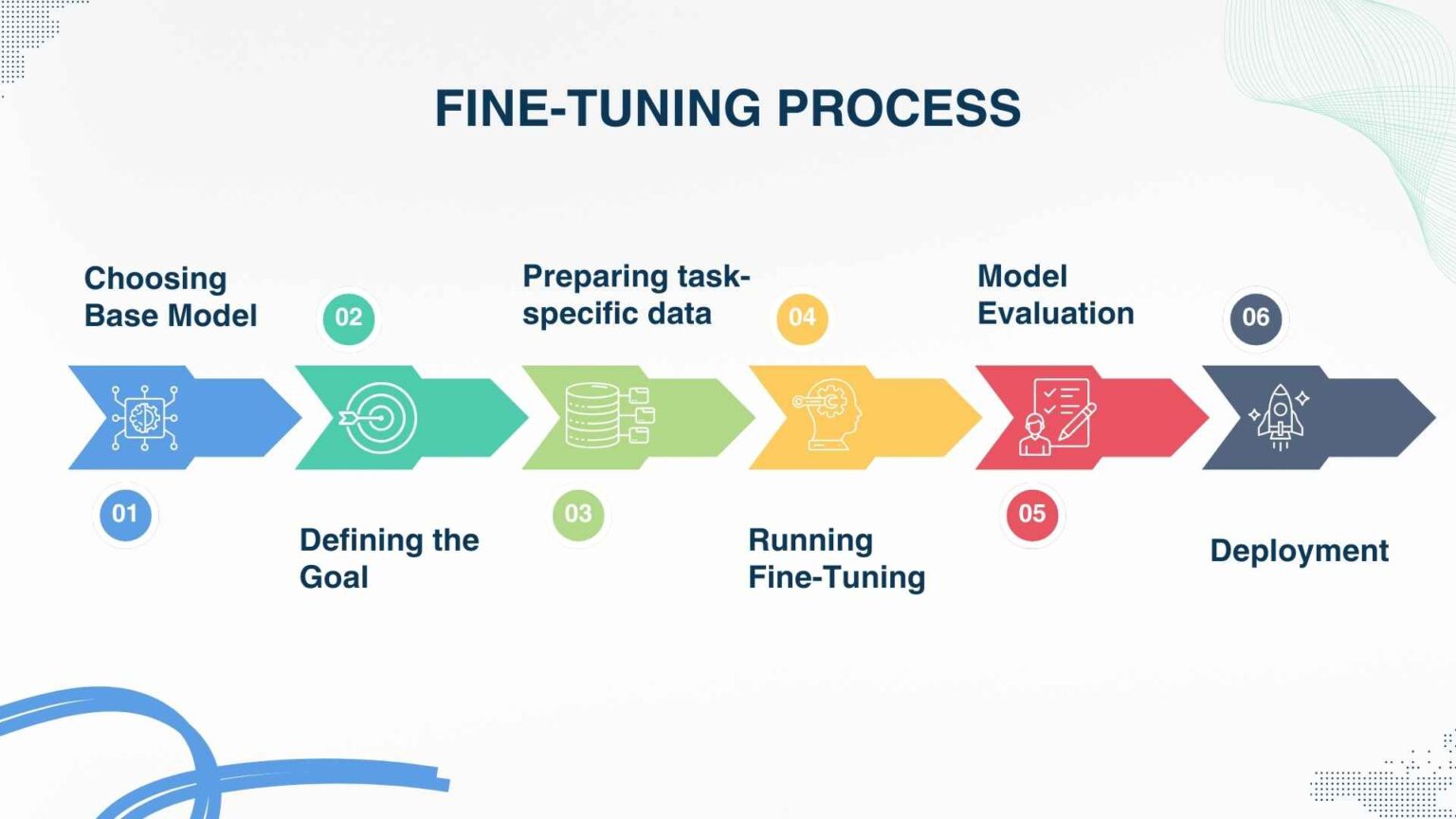
Ai fine-tuning is a structured approach that transforms a general AI model into a system that is customized to your business needs. When the right steps are followed, it ensures that your custom AI model learns from accurate, task-specific data and delivers reliable, domain-specific AI outputs. Here’s a step-by-step look at the process:
1. Choosing a Base Model
The initial step when it comes to fine-tuning is choosing a high-quality pre-trained model. The base model should already have strong language understanding, reasoning, or analytical skills. When you choose the right foundation, it ensures that your model adaptation starts on solid ground and allows faster and even more effective fine-tuning.
2. Defining the Goal
The second step involves defining the objectives of your fine-tuning project. Determine what tasks your AI model should handle, no matter if it’s customer support, workflow automation, report generation, or even content creation. When you have a clear goal, it helps you guide task-specific training and make sure your workflow-specific AI aligns with your business priorities.
3. Preparing Task-Specific Data
Gather and organize the data they will learn from, which includes internal documents, example workflows, product information, or even domain-specific terminology. High-quality, clean, and relevant data is really crucial as data-trained AI depends on it in order to produce accurate and consistent outputs that are customized to your organization.
4. Running the Fine-Tuning Step
During this phase, the AI actually adjusts its internal parameters in order to reflect your business context perfectly. Furthermore, this is the core of AI fine-tuning, where exactly your custom AI models become capable of comprehending workflows, brand tone, along with industry-specific patterns, and generate responses that are far more relevant than generic models.
5. Model Evaluation
After fine-tuning, the model is tested against predefined objectives. This involves checking for accuracy, consistency, as well as performance across different tasks. Any gaps are addressed through further model optimization, additional training, or even redefining task-specific training datasets, and ensuring the AI meets your requirements.
6. Deployment & Ongoing Monitoring
Finally, the fine-tuned domain-specific AI is deployed for real-world use. Ongoing monitoring actually tracks performance, handles new edge cases, and updates the model with fresh data as the workflow grows. Now, this ensures your workflow-specific AI remains efficient, accurate, along with fully aligned with your business preferences.
Types of Fine-Tuning
AI fine-tuning has several forms based on different objectives, data, and the tasks you exactly need the model to handle. So, choosing the right type ensures your custom AI models are accurate, reliable, and aligned with your workflow. Here are different types of fine-tuning:
1. Full Model Fine-Tuning
This model updates all parameters of the base model and creates highly specialized domain-specific AI. It’s really the best for complex tasks with large datasets, delivering the most precise results.
2. Partial Fine-Tuning
As the name suggests, it only updates certain layers of the model. This type of model is perfect for smaller datasets; it also adds task-specific training without even losing general knowledge.
3. Adapter-Based Fine-Tuning
This type of fine-tuning utilizes small modules added to the model in order to learn business-specific tasks. Creates lightweight data-trained AI that’s really easy to update.
4. Prompt-Based Fine-Tuning
Prompt-based fine-tuning focuses on redefining prompts rather than model parameters. These are great for workflow-specific AI with minimal training data.
5. Reinforcement Learning with Human Feedback (RLHF)
Each type of AI fine-tuning has its own advantages, and the choice depends on your business needs, data availability, and required precision.
Key Advantages of Fine-Tuning
1. Higher Accuracy for Real Business Tasks
AI fine-tuning makes the model learn your industry terms, workflows, and rules, and it leads to far more precise results than a generic model.
2. Consistent and On-Brand Outputs
Fine-tuned models follow your tone, structure, along compliance needs, and provide you with reliable domain-specific AI every time.
3. Faster Work and Lower Costs
When the AI understands your processes, it then completes tasks with almost no errors, saves time and reduces operational costs.
4. Strong Performance on Specialized Tasks
Fine-tuning adds task-specific training and helps the model handle technical or even context-heavy activities far better.
5. Smarter Use of Your Proprietary Data
Your internal data actually becomes a strength, building custom AI models trained on information competitors can’t access.
Where Fine-Tuning Is Commonly Used?
- Customer support automation
- Legal document analysis
- Financial forecasting and reporting
- Healthcare data interpretation
- E-commerce product classification
- Fraud detection and risk analysis
- Sales and CRM automation
- Content generation and brand writing
- Code generation and debugging
- HR automation and resume screening
- SaaS workflow automation
- Knowledge base optimization
- Manufacturing process monitoring
- Research and technical analysis
Choosing Among Fine-Tuning, Prompting, and RAG
- When Fine-Tuning Works Best: AI fine-tuning is the best choice whenever you need the model in order to understand your domain deeply, follow strict rules, or even produce consistent outputs. It’s really great for structured tasks such as compliance content, technical analysis, or even processes that must remain accurate every time.
- When Prompt Engineering Is Enough: Prompt engineering works well when your requirements are totally simple, or even if they’re flexible. If you want improvements without even training a model, then better prompts can guide the AI effectively for creative work, brainstorming, or even general queries.
- When RAG Is the Better Option: RAG is the better alternative when accuracy relies on fresh, verified information. As it retrieves answers from your documents or database, it’s perfect for knowledge bases, product catalogs, policies, FAQs, as well as any workflow where information changes frequently.
Why Choose Cleverbits For AI Fine-Tuning
Choosing the right partner matters when you want dependable, business-ready AI. Cleverbits brings a mix of precision, speed, and practical experience that helps companies get real value from AI fine-tuning without the usual complexity.
What Makes Cleverbits Stand Out
- Deep expertise in creating custom AI models trained on your own data and workflows.
- Cleverbits has deep expertise in creating custom AI models trained on your own data and workflows.
- Zero-hallucination architecture that primarily focuses on accuracy and reliable output quality.
- Domain-focused approach that perfectly builds industry-specific AI customized to your operations.
- Fast deployment pipelines are designed in order to reduce engineering time and speed up results.
- Continuous monitoring and optimization just to keep your fine-tuned models stable and aligned as your data evolves.
- A clear collaborative process that truly helps non-technical teams adopt AI without even any confusion.
Cleverbits gives you an AI model that isn’t just powerful, but genuinely usable in the day-to-day tasks your teams handle exactly what you expect from a trusted custom AI development company.
Conclusion
Fine-tuning really plays an important role in taking AI from a general tool to something that genuinely understands your business. It actually strengthens accuracy, improves reliability, while allowing the model to learn through internal knowledge rather than broad, generic data. When you combine all these with several methods like promoting and RAG, it becomes even more flexible, and gives you multiple ways to solve operational challenges.
As more and more organizations look for smarter organizations and deeper insights, fine-tuning provides you with a straightforward path to building AI systems that truly support your day-to-day decision-making. If you want an AI model that’s shaped around your domain, processes, and goals, then Cleverbits is the right place to start.