


What Are Custom AI Agents? Simple Explanation With Real Enterprise Use Cases
Think of custom AI agents as the digital version of a highly trained specialist who truly understands your business inside and out. These agents don’t just follow pre-set rules. Over and above that, they also analyze data from different systems, understand why something is happening, and decide what to do next. That’s exactly why, when people ask what are custom AI agents?, the most accurate explanation is that they act as intelligent operators designed in order to solve problems that ordinary automation can’t handle.
In various companies, these agents actually manage workflows, predict issues before they even escalate, and make routine decisions that typically consume several hours of manual effort. As AI agents automation is being advanced rapidly, their role has shifted from simply reducing workload to actually improving how exactly a business functions.
In this guide, we’ll walk you through how these agents work, the advantages they provide, along with the types you can deploy, enterprise use cases, key challenges, and how Cleverbits helps businesses build and launch their custom AI agents that truly make an impact.
What are Custom AI Agents?
Custom AI agents are smart software systems that are specially designed to understand a goal, analyze what needs to be done, and take precise action on their own. Different from normal automation that follows a fixed script, these agents are trained to learn from data, adapt to new situations, and make perfect decisions based on context. You can think of these custom artificial intelligence agents as your team members built for a specific role in your organization.
A custom AI agent is actually trained on your business data, processes, along with tools. And, this allows it to handle multiple tasks that would normally need human judgment. For example, it can review customer queries, monitor inventory patterns, generate reports, or even coordinate tasks across multiple systems without even needing someone in order to guide step by step.
These agents combine several capabilities under the hood:
- Understanding instructions and breaking them into smaller steps.
- Accessing real-time data from different tools or software.
- Choosing the best action based on rules, patterns, or predictions.
- Learning from new inputs so performance improves over time
The reason businesses desire custom AI agents over generic automation is actually that they behave more like purposeful operators instead of simple rule followers. They work with reasoning, not just competition. These models adapt as your organization grows and continue to improve the more even they interact with your systems.
In simple terms, a custom AI agent is a flexible, intelligent worker designed in order to operate parts of your business smoothly, consistently, and with far fewer errors.
How Do Custom AI Agents Work?
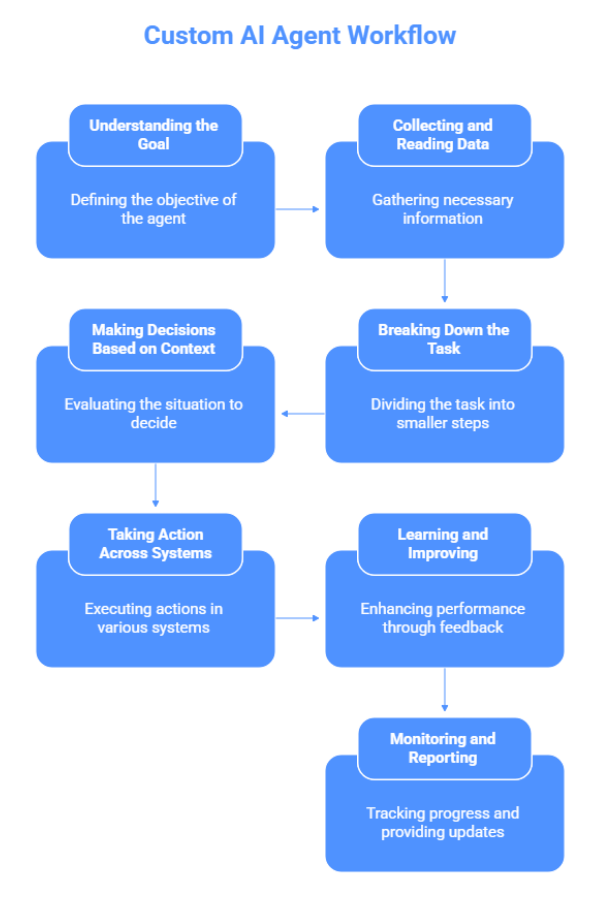
These custom AI agents actually work by combining data, reasoning, and automation in order to carry out tasks that generally need human attention.
Rather than following a strict rule-based script, they utilize a combination of machine learning, real-time analysis, along with decision logic to understand what exactly needs to be done and then execute it. This is exactly why AI agent automation feels even more intelligent and adaptive if we compare it to traditional workflows.
Here’s a simple breakdown of how the whole process works:
1. Understanding the Goal
Everything starts with defining what the agent should achieve. It might be resolving customer queries, analysing financial patterns, scheduling tasks, or even coordinating systems in the background. The clearer the goals, the smarter the agent behaves.
2. Collecting and Reading Data
These AI solutions get connected with your existing tools like CRMs, ERPs, ticketing platforms, analytics dashboards, or even databases. They extract the information they exactly need and understand it through natural language processing and machine learning. This is the foundation of every strong AI agent’s business application.
3. Breaking Down the Task
Once the agent understands the problem, it then decomposes it into smaller steps. For instance, if the task is about processing an invoice, it may read the documents, match details along with records, validate numbers, and then approve or flag issues.
4. Making Decisions Based on Context
Instead of blindly following a rule, a custom AI agent uses reasoning models to choose the best next action. It looks at past data, patterns, probability, and business logic. This gives it the ability to adjust when something changes or an unexpected scenario appears.
5. Taking Action Across Systems
After deciding what to do, the agent acts. It might send an email, update a record, trigger a workflow, or run an automated sequence. This cross-platform execution is what makes AI agent automation so powerful.
6. Learning and Improving
With every interaction, the agent gets better. It collects feedback, analyses outcomes, and updates its internal model. Over time, it starts handling tasks faster and more accurately, almost like a well-trained employee who constantly refines their skills.
7. Monitoring and Reporting
Custom AI agents don’t just execute tasks. They also track the performance of each workflow, highlight bottlenecks, and generate insights that help teams make better decisions.
What Are the Benefits of AI Agents?
Custom AI agents provide a unique combination of speed, precision, and intelligence that routine automation tools cannot offer. They make businesses smarter by eliminating monotonous jobs and facilitating better management. Among the major benefits are:
- Quicker execution of regular workflows
- Fewer human errors and greater precision
- Instantaneous insights that aid decisions
- Uninterrupted performance without exhaustion or waiting
- Possibility of expansion of business operation without the accompaniment of increased staff
- Better customer satisfaction due to rapid, aware of the context, responses
- Easy assimilation with the already in place tools and software
- They turn into digital co-workers, who foster the growth of the business, make operations efficient and allow the employees to concentrate on the tasks that are of high value.
Benefits of Small Language Models
Types of Custom AI Agents
1. Task Automation Agents
Perform repetitive work such as entering data, modifying records, or document processing.
2. Analytical Agents
Analyze data, predict future events, and draw conclusions from extensive datasets.
3. Customer Support Agents
Grasp issues, give tailored replies, and forward complex matters to the appropriate team.
4. Workflow Orchestration Agents
Examine the alternatives and select the best course of action by applying rules, reasoning, and circumstances.
5. Decision-Making Agents
Lower power consumption makes SLMs a sustainable AI option.
6. Monitoring Agents
Monitor the condition of the system, recognize unusual activities, and inform the teams before the problems become serious.
Each one of them is tailored for a specific AI agent business application, which varies depending on the objectives and internal procedures.
How to Implement AI Agents in Your Business?
Bringing in AI agents does not have to be a difficult process. If only structured methods were used, then the transition would be smooth and would yield positive results. Below is a shorter, yet still practical, roadmap:
- Locate a problem area where automation can have the biggest impact.
- Sketch out current workflows and eliminate any steps that do not add value.
- Select the most suitable type of AI agent to perform the task.
- Link your internal tools, databases, and software.
- Instruct the agent on appropriate data and business rules.
- Conduct controlled trials to certify its dependability.
- Gradually launch and keep an eye on progress.
- Adjust the agent’s reasoning in light of the feedback from users and the results.
- Adhering to these directions, you will be able to incorporate AI agent automation in a manner that enhances productivity instead of complicating the process.
How Cleverbits Helps You Build and Deploy Custom AI Agents?
The development of custom AI agents is made easy by Cleverbits, which provides custom ai solutions according to the requirements of your business. They first analyze your workflows and data, and then create AI agents that are custom and fit well into your present systems.
Cleverbits oversees the whole process from making and testing to launching and constantly improving the agents so that the agents are always reliable and smart. The end product is a smart, expandable digital helper that is efficient in performing tasks, cuts down on human labor and assists in making your business thrive, all without the hassles that come with traditional automation tools.
Conclusion
Custom AI agents are really transforming how exactly businesses operate just by combining intelligence, automation, along with learning. These agents actually streamline workflows, reduce errors, and unlock insights that were previously hidden in complex data.
When companies implement this solution thoughtfully, they can boost efficiency, scale operations, and make smarter decisions. And, if you’re also willing to implement an AI agent that is customized to your business, you can opt for Cleverbits.
